25 . 10 . 25
25 min read

How To Verify Your Leads BEFORE They Reach Your Pixel – Optimizing Your Ad Targeting Instantly
Right now, while you’re reading this, your ad campaigns are learning to ta...

Right now, while you’re reading this, your ad campaigns are learning to target bots. Not intentionally—but because every bot, fake email, and invalid phone number that slips through your forms is teaching your pixel that these are your “ideal customers.” Automated AI bots are taking over the internet and making this problem much worse.
You’re not alone. Every business advertising online faces this invisible threat, and most don’t realize it’s happening until they’ve already wasted thousands of dollars training their algorithms on corrupted data.
Here’s what’s actually happening to your lead forms right now. Someone clicks your ad, lands on your page, and submits a form. Spammers submit your form with a bad email, with no intention of ever purchasing your product. Maybe they entered a disconnected phone number from three years ago. Or maybe they’re not a person at all—just a bot programmed to scrape and submit contact forms across the internet.
Your form accepts the submission. Your pixel fires. Your CRM records the lead. And your ad platform registers this as a “conversion” worth optimizing toward.
According to IBM, the average business discovers that 18% of their form submissions contain inaccurate data. That single-digit percentage might not sound alarming until you do the math. For every $10,000 in ad spend, you’re losing $1,800 to leads that were never real in the first place. Scale that to $50,000 monthly, and you’re burning through $9,000 on fictional customers.
But the real damage goes far deeper than wasted spend. The fake leads aren’t just costing you money—they’re actively sabotaging your future campaigns.
Modern advertising platforms are remarkable machines. Facebook’s algorithm, Google’s Smart Bidding, TikTok’s optimization engine—they all learn from your conversion data to find more people like your customers. Feed them accurate data, and they become increasingly precise at identifying your ideal audience. Feed them garbage, and they optimize toward chaos.
When your pixel receives a conversion signal from “[email protected]” or from a bot that filled out your form in 2.3 seconds, the algorithm doesn’t know that lead is worthless. It only knows that this particular combination of behaviors, demographics, and interests resulted in a conversion. So it goes looking for more people who match that profile.
This creates what we call the Ad Doom Loop. Bad leads reach your pixel. Your pixel optimizes for bad audiences. You waste money targeting bots and irrelevant users. Conversion rates drop, cost per acquisition (CPA) rises, and return on ad spend (ROAS) falls. The more this happens, the harder it becomes for your campaigns to recover—because your data foundation is fundamentally broken.
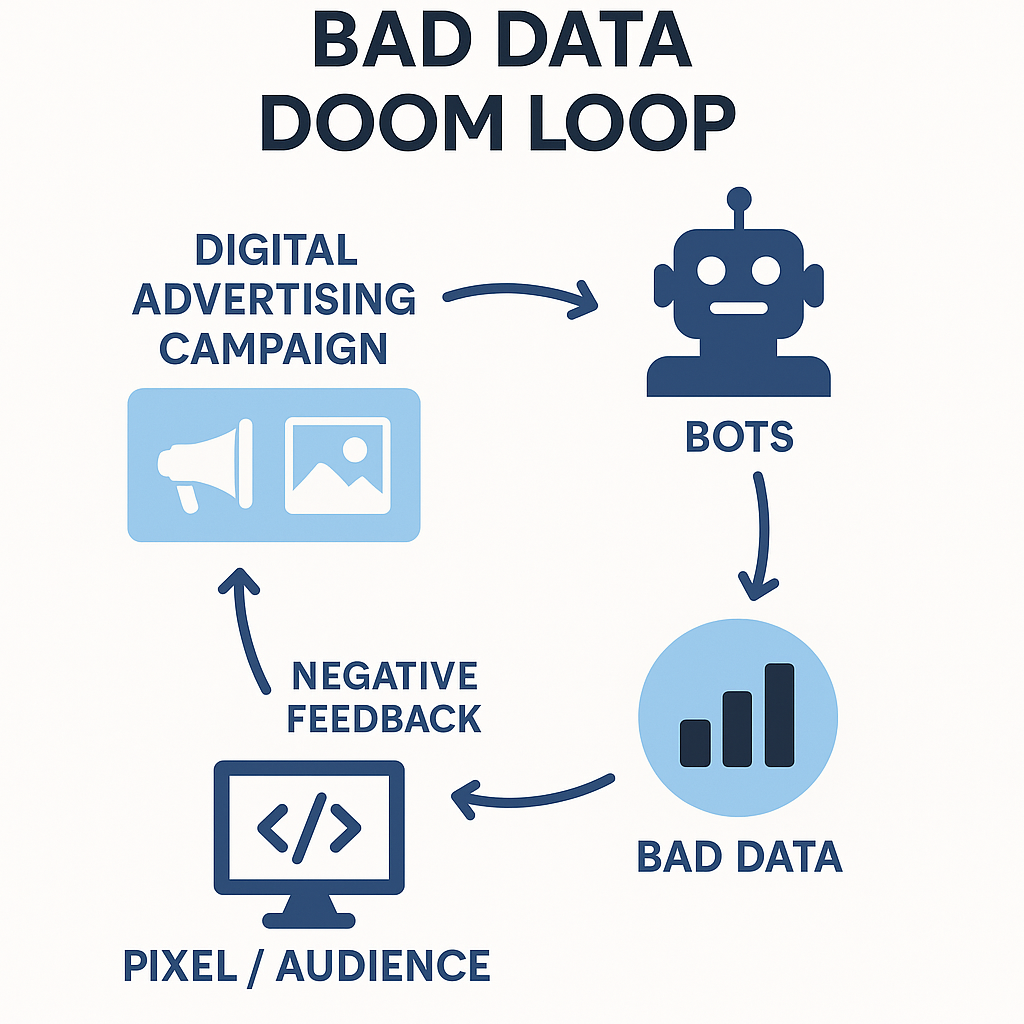
Consider how this plays out with Facebook’s Lookalike Audiences. You upload your customer list to create a lookalike for targeting. But if 18% of that list consists of page visits from bots, fake emails, and invalid contacts, Facebook builds your audience around a corrupted dataset. You’re essentially telling the algorithm “find me more people like these bots and typos.” The lookalike expands outward from a center point that doesn’t exist.
This quickly creates a negative feedback loop that causes the ad algorithms to target more bots and more bad actors submitting bad data. Over time, your ad campaign begins to degrade, and each week, your campaign metrics get worse and worse as more bad data is fed into the system.
Google’s Smart Bidding suffers the same fate. The system adjusts your bids based on conversion probability, but it’s calculating probability using signals from leads that never convert into customers. Your automated bidding strategy becomes confident about the wrong patterns, pushing spend toward placements and audiences that generate form fills but not revenue.
LinkedIn’s audience expansion, TikTok’s interest targeting, every platform’s optimization engine—they all depend on clean signals. Pollute those signals, and every optimization works against you.
Most companies eventually realize they have a data quality problem. So they build cleanup processes. Someone manually reviews new leads each morning, deleting obvious fakes. Or they install validation on their CRM side, filtering bad data before it reaches their sales team.
These approaches solve half the problem. Your sales team stops wasting time on fake leads. But your ad campaigns? They’re still learning from corrupted data, because the pixel fired the moment that form was submitted—before anyone checked if the lead was real.
The fix requires thinking differently about when validation happens. Instead of cleaning data after it’s collected, you need to verify submissions before they trigger pixel events. Intercept the bad data at the source, and your ad platforms never learn the wrong lessons.
Here’s what real-time verification looks like in practice. Someone fills out your form and clicks submit. In the milliseconds before that submission completes, verification systems scan the data. They check if the email domain exists and if the specific address can receive mail. They verify the phone number connects to a real carrier and hasn’t been flagged for fraud. They analyze the submission speed, mouse movements, and behavioral patterns to detect bot activity. They examine the IP address for VPNs, proxies, or geographic anomalies. They scan the message content for spam keywords and suspicious patterns.
If everything checks out, the submission completes normally. Your pixel fires with a verified conversion. Your CRM receives a quality lead. Your ad platform learns from real customer behavior.
If the verification fails, the submission either gets blocked or flagged—but critically, your pixel never fires. As far as your ad algorithm knows, that interaction never converted. No bad signal enters your optimization loop.
This is the fundamental difference between cleaning data and preventing contamination. One fixes the symptom after the damage is done. The other stops the problem at its source.
Setting up real-time verification requires connecting three components: your website, a verification service, and your tracking pixels. Here’s the complete implementation process.
Start by gathering information about your current setup. You’ll need administrative access to your website—specifically the ability to add code to your site’s header section. You should know which forms need protection (contact forms, demo requests, quote forms, newsletter signups).
You’ll also want to understand your current tracking setup. Which pixels are active on your site? Facebook Pixel, Google Ads conversion tracking, LinkedIn Insight Tag? Knowing this helps you verify everything continues working correctly after implementation.
Once you’ve signed up Authenticity Leads, you’ll land in a dashboard that shows your account status, usage metrics, and configuration options. Look for a section labeled “Authorized Websites” or “Clients” or “Get Started”—this is where you’ll find your unique JavaScript snippet.
The snippet is a small piece of code, usually between five and fifteen lines, that looks something like this:
<script src='https://code.authenticityleads.com/js/rOzFwtWI.js' type='module'></script>Your specific snippet will have a unique identifier tied to your account. Copy this entire code block—you’ll need it in the next step.
Understanding the impact timeline helps set realistic expectations. Some benefits appear immediately, while others unfold over weeks.
Week One: You’ll immediately stop wasting money on fake leads. If you were getting 20 bot submissions per week at a $50 cost per lead, you’ve just saved $1,000 weekly. Your sales team stops chasing dead ends. Your CRM stays cleaner.
Weeks Two to Four: Your ad platforms begin the relearning process. They’re now optimizing toward real humans who provide valid contact information. You might notice your conversion volume dip slightly as bots are excluded, but the quality of leads improves dramatically. Your lead-to-opportunity rate should increase, leading to more sales.
Weeks Four to Eight: Algorithm optimization becomes evident. Your cost per acquisition starts declining as platforms get better at finding real prospects. Your Lookalike Audiences become more precise. Your automated bidding strategies grow more confident about the right patterns. If you’re running conversion campaigns, you’ll see efficiency gains.
Month Three and Beyond: You’ve built a foundation of clean data. Every new conversion strengthens your algorithm’s understanding of your true customer. Your campaigns compound these gains over time. Customer acquisition costs stabilize at a lower baseline. Return on ad spend improves and holds steady.
A personal injury law firm running aggressive paid campaigns was spending $70,000 monthly to acquire approximately 100 leads. They calculated their cost per lead at $700, which felt expensive but acceptable in their competitive market. What they hadn’t calculated was how many of those leads were real.
After implementing real-time verification, they discovered 22 of those 100 monthly leads were invalid—fake emails, disconnected numbers, or bot submissions. They’d been spending $15,400 per month on leads that never had a chance of becoming clients. More critically, those 22 fake leads had been teaching their Facebook and Google campaigns to find more people like them.
Within six weeks of verification going live, their true cost per lead dropped from $700 to $574—an 18% improvement. But the real wins came from volume. With the same $70,000 budget now optimizing toward real prospects, they acquired 122 valid leads instead of 78. That’s 44 additional opportunities per month, and in personal injury law, each case can be worth tens of thousands in fees. The math was staggering: verification added over $60,000 in annual profit while simultaneously reducing wasted spend.
A B2B SaaS company selling project management software faced a different problem. Their $25,000 monthly ad budget was generating 200 demo requests, but their sales team could only convert 40 into paying customers—a 20% conversion rate that was puzzling their VP of Sales. Why were so many “interested” prospects ghosting after booking demos?
Verification revealed the answer. Thirty-five of those 200 demo requests each month came from invalid emails or competitor intelligence gathering. Some were from bots scraping their form to harvest data. Others were from people using temporary email addresses to access gated content with no intention of buying. Their actual lead-to-customer conversion rate wasn’t 20%—it was 24%. Their sales team was performing better than anyone realized.
More importantly, their ad campaigns had been optimizing toward these fake demo requests, thinking they were ideal customers. After implementing verification and giving their pixels eight weeks to relearn, their cost per demo dropped 27%, and they increased their valid demo volume to 215 per month at the same budget. Revenue per marketing dollar increased by 31%.
An e-commerce retailer running quiz funnels to segment customers noticed something odd. Their Facebook campaigns were driving thousands of quiz completions, but email conversion rates were terrible. Only 8% of people who completed the quiz and joined their list actually made a purchase. Industry benchmarks suggested they should be seeing 15-20%.
Verification uncovered massive form spam. Automated bots were completing their quiz thousands of times, submitting randomized answers with fake email addresses. These bots were inflating their conversion numbers, making their campaigns look successful while actually diluting their email list and corrupting their pixel data.
After implementation, their quiz completion numbers dropped by 40%—which initially looked bad until they checked email performance. Their purchase conversion rate jumped from 8% to 19% because they were now only emailing real humans who had genuinely taken their quiz. Their email sender reputation improved, their open rates increased, and their revenue per email sent doubled. The smaller list was exponentially more valuable than the larger, polluted one.
The examples above share a common thread: these businesses didn’t know they had a problem until they measured it. Their dashboards showed conversions. Their CRMs showed leads. Everything looked fine on the surface. But beneath that surface, their most important asset—their data—was compromised.
The insidious nature of bad data is that it doesn’t announce itself. There’s no alert that says “Warning: 18% of your leads are fake.” No notification that your pixel just learned from a bot. The corruption happens silently, and its effects compound invisibly until one day you realize your campaigns aren’t performing like they used to, and you have no idea why.
This is why prevention beats cleanup. Once your algorithm has learned from thousands of bad conversions, unwinding that learning takes months. You’re not just stopping the bleeding—you’re trying to repair damage to a system that’s already been trained incorrectly. Every day you delay is another day your campaigns optimize toward the wrong patterns.
But there’s an opportunity cost too. While your competitors verify their leads and train their algorithms on clean data, their campaigns become increasingly efficient. They acquire customers at lower costs. They scale faster. They compound their advantages week over week. The gap between your performance and theirs widens not because they’re better marketers, but because they’re working with better data.
“Won’t I accidentally block real leads?”
Modern verification systems are sophisticated enough to distinguish between mistakes and fraud. When someone types “[email protected]” instead of “gmail.com,” the system can suggest the correction before blocking them. Legitimate leads that fail one validation check might pass others—for instance, a real person using a new phone number might not pass phone verification but will pass bot detection. The scoring algorithms consider the whole picture. In practice, false positives (real leads incorrectly blocked) occur in less than 2% of cases when the system is properly configured.
“How quickly will I see results?”
The timeline depends on what you measure. Immediate results include stopping wasted spend on fake leads and reducing your sales team’s time on invalid contacts. Medium-term results (four to eight weeks) include improved cost per acquisition as your algorithms retrain. Long-term results (three months plus) include sustained efficiency gains and better overall campaign performance. The key is giving your ad platforms enough time to relearn what a real conversion looks like.
“What if my leads come from platforms I don’t control?”
If you’re running lead ads directly on Facebook or LinkedIn, where users submit forms without visiting your website, verification works differently. Many platforms offer built-in validation options—enable them. For leads that do reach your website, you control the verification. For leads from third-party sources, you can verify them as they’re imported into your CRM before they’re uploaded to ad platforms for targeting.
“Isn’t this making the user experience worse?”
The opposite is true. When someone makes a typo in their email and submits your form, they’re not getting your follow-up emails and probably assume you’re ignoring them. Verification catches that typo in real-time and helps them fix it. When a bot attacks your form, verification blocks it silently without affecting real users. The only people who experience friction are those trying to submit invalid data—and you don’t want them anyway.
“My conversion volume is low already. Can I afford to block any submissions?”
This is exactly backward. If you’re running tight campaigns where every conversion matters, you especially can’t afford to train your pixel on fake data. A small campaign with 10 monthly conversions where 2 are fake means 20% of your optimization data is wrong. That’s worse than a large campaign with the same percentage, because you have less real data to offset it. Quality matters more than quantity when training algorithms.
Let’s make this concrete with a thought exercise. Calculate your current monthly ad spend and multiply it by 0.18 (the industry average bad data rate). That’s your minimum monthly waste—the money you’re spending to acquire leads that aren’t real. Now multiply that number by 12 for your annual waste. For most businesses, this calculation is sobering.
But remember, that’s just the direct cost. The indirect cost is harder to quantify but potentially larger. How much worse are your campaigns performing because they’ve been trained on bad data? What’s the cumulative effect of weeks or months of corrupted optimization? If your cost per acquisition could be 15% lower with clean data, what would that mean for your customer acquisition volume or your profit margin?
There’s also the opportunity cost of not acting. Every month you wait is another month your competitors might be pulling ahead. Another month of training your algorithms incorrectly. Another month of compounding bad decisions in your automated bidding and targeting.
The question isn’t really whether you can afford to implement verification. It’s whether you can afford to keep operating blind, hoping your data is clean enough, while your campaigns learn from ghosts and bots.
Your marketing data is the foundation of everything else you build. Every campaign optimization, every audience expansion, every algorithmic improvement depends on the quality of the signals you provide. Pollute those signals, and everything built on top of them becomes unreliable.
Lead verification isn’t a nice-to-have feature for mature marketing organizations. It’s essential infrastructure for anyone spending money on digital advertising. The same way you wouldn’t run campaigns without tracking pixels or analytics, you shouldn’t run them without data verification.
The implementation takes an afternoon. The impact lasts forever. From the moment verification goes live, every conversion that reaches your pixel is real. Every lead that enters your CRM is valid. Every optimization your ad platform makes is based on actual human behavior, not bots and typos.
Your campaigns will never be perfect—there are too many variables in digital advertising for perfection. But you can make them optimize toward truth instead of fiction. You can train them on reality instead of noise. You can build your growth on a foundation that won’t crumble.
Every day you wait is another day of corrupted data flowing into your systems. Another day of wasted spend. Another day of algorithms learning the wrong lessons. The tools exist to stop it right now.
The choice is yours, but the clock is ticking. What will you optimize for tomorrow—reality or ghosts?
Ready to protect your campaigns? Learn how Authenticity Leads verifies every submission before it reaches your pixel at authenticityleads.com
25 min read
13 min read

9 min read

